
Becoming Communities of Hope in a World on the Move
Published on November 3, 2026
What does hope look like when families are separated, children are vulnerable, livelihoods disappear and communities are forced to leave everything familiar behind?
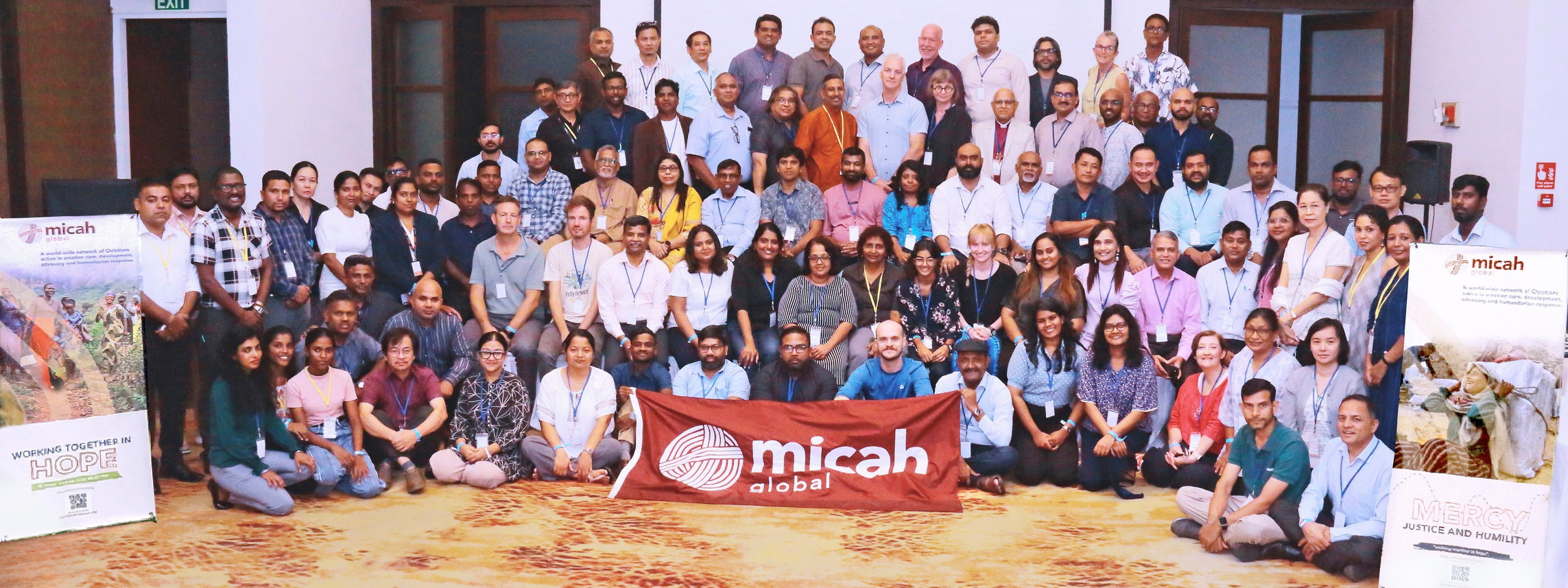
This was the question at the heart of Micah Connect Asia 2026, where 96 church leaders, practitioners and advocates from across Asia gathered in Negombo, Sri Lanka, in October under the theme "Finding Hope: Responding to Issues of Migration and Displacement in Asia."
Behind every number is a real person with a story!
Over three days, participants moved beyond statistics and headlines to explore the human realities behind migration and displacement. Through stories, biblical reflections, plenaries and interactive workshops, they confronted the interconnected challenges of conflict, climate change, economic insecurity, trafficking, exploitation, family separation and protection. They also wrestled with what it means for the Church to respond - not simply with assistance, but with justice, mercy, dignity and hope. To some Micah Connect Asia became a space for a changed perspective, for others an encounter and also an opportunity to reflect for committment.
Participants were challenged and enlightened to think differently. The Feedback Survey showed that 94.7% of attendees eported a paradigm shift in thinking and theology in relation to the migration and displacement: "The term migrant was RE-DEFINED for me" and "The conference helped me to have deeper understanding around migration and displacement. The way the Biblical perspective was woven around this topic was excellent and shaped my thinking around this issue and concern!"
A recurring message emerged: these challenges are too interconnected for any one organisation, church or community to address alone. Learning from one another, sharing experiences across countries and building stronger relationships opened possibilities for greater collaboration and collective action.
Participants also affirmed their commitment to child-sensitive responses to migration and displacement through a shared pledge to protect children on the move.
The consultation extended beyond discussion rooms through field visits to local initiatives in Sri Lanka, bringing participants face-to-face with community realities and practical expressions of resilience, protection, family restoration and care.
Upon reflection of the field visits, participants commented, "it gave me tools to communicate migration and displacement with churches" and "There are so many great localised response activities being done by many organisations and churches, it was refreshing to hear what is being done and the many great solutions".
As the consultation drew to a close, the challenge was no longer simply what participants had learned, but what they would do with it. How can churches and Christian organisations become communities where displaced people find welcome, dignity, protection and belonging? How can connections become collaboration, and shared learning become collective action?
One participant wrote, "My key takeaway is that the church must move beyond charity to justice and long-term transformation. I want to be more intentional in ensuring that the communities we serve, particularly the most vulnerable, are not just recipients of assistance but active participants in shaping their own futures". Another said they were challenged towards "Welcoming people and how can I and a Christian, and we as a church in Australia stand up for justice when the rise in anti-migration and immigration takes hold?"
A key highlight was the opportunity for participants to share experiences from their own countries, strengthening regional connections and identifying opportunities for greater collaboration between churches, local leaders and community organisations. Participants also signed a Pledge on Child-Sensitive Migration and Displacement, affirming their commitment to protecting the rights, safety and well-being of children on the move.
Finding hope is not about ignoring the realities of uprootedness. It is about choosing to respond together.
As Micah Connect Asia closed, a participant shared: "Each displaced person has lost their identity and home... and I now know how the church can be a new home".
As participants returned to their countries and communities, they carried a renewed commitment to become communities of hope – creating pathways to safety, dignity and belonging, and walking alongside those experiencing migration and displacement.
They carried an invitation that extends to all of us: to see those who are uprooted, draw near, cross boundaries and become communities through which God's hope is made visible.